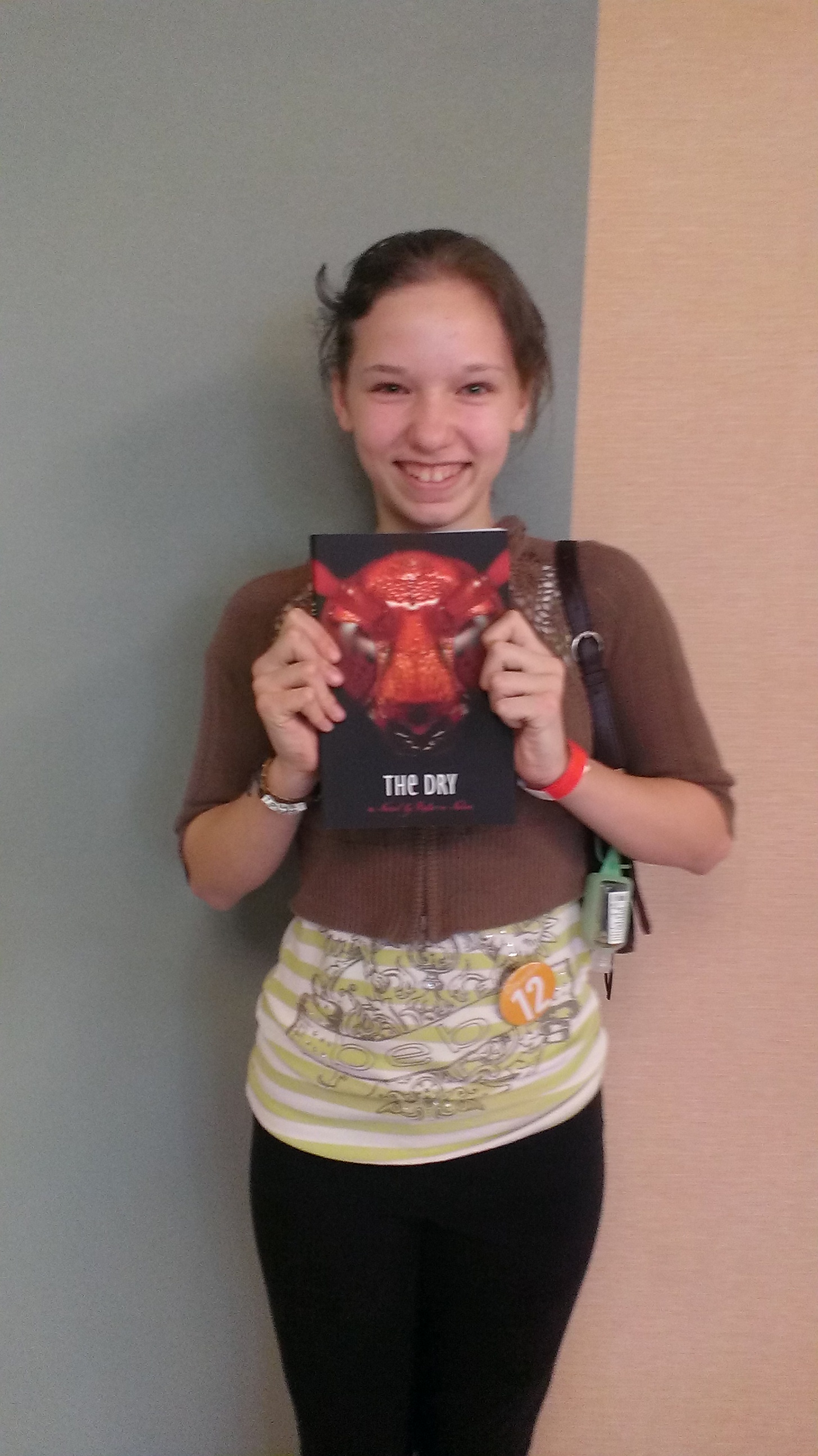
Nora bought all of her friends and family books at the festival.
It was refreshing to be involved with a group of enthusiastic and happy authors yesterday at the Montgomery County Book Festival at the Lone Star College. The best thing of all was that there were a lot of kids who were very interested in books, and in authors.
My fellow Houston Writer’s Guild members were delighted to find that we attracted a lot of teens to our table. Many of them bought our books. How lovely to see such enthusiasm from the kids and their parents.
I’ve been so excited to have two books published on Amazon. The Dry continues to get good reviews. I’m so grateful. It takes many hands and many eyes to get a book ready for publication. I feel like those who have published before me have been the most helpful in the process.
I published a second book in January called Deadly Thyme. I had had it professionally critiqued. I followed all her good suggestions. I read and reread the file. I was certain it was perfect. The cover was outstanding. Everything looked good. I’d been working on this book for so long, and had so many people read it that I felt positive it was ready. Sure, there were likely some mistakes because there always is. I figured that there would perhaps be three or four, and those would be easily fixed. So I went ahead and pushed “publish.”
This was my mistake.
I sent the completed paperback to someone who has a good eye for mistakes. She took me aside and showed me that there were more than three or four mistakes. There were many. There are many. I’m so ashamed. I want to apologize to any and all who have bought Deadly Thyme. I have since removed the paperback from Amazon. When it reappears it will be better! The Kindle will be down within the week and a new version will be uploaded.
There is good news for anyone who bought a Kindle version. (And I hope it is in your queue of books to read and not already been read. Wait!) If you go to your Amazon Kindle page where all your books are stored, you can make sure your “updates enabled” is on and you will get a better file on your device automatically when the new file is downloaded. This works on the Kindle app on your computer or phone too, you only have to go to “manage your device” and you will be directed to your Amazon Kindle page.
I’m truly upset by this because my books are only as good as their stories, and stories should be read without the distraction of extra words, missing words, too many dashes and not enough commas. I don’t expect you to trust an author whose book is chock-a-block full of mistakes. I don’t expect you will trust that someone who published a book with that many mistakes would be trusted with other novel offerings in the future. I hope this isn’t so, that you will forgive me and understand that I won’t let it happen again.
The time has come, the time is now… to announce the novel. TA DA!
I began this novel in 2004. Originally, the opening scenes included a fight between two men witnessed by a child and a mine collapse. These two events are not in the present novel. Sometimes an author must delete the best scenes in order for the story to move forward in a timely manner.
Don’t worry, the novel is full of things that will keep the reader turning pages.
The story is much like a Wizard of Oz story with a little boy as protagonist. He is sent on a quest (as Dorothy had to retrieve the witch’s broom), one that he does not want to go on. He does. All the plot elements are there. There are no flying monkeys. I don’t want you to be disappointed so there are giant insects. “For good or evil who is to say?”
Here is what the back cover says to explain in less than 200 words what the book is about:
West Virginia, 1895.
A deadly dry spell has left the earth parched and souls desperate. Crops are failing. Cities are starving. A missing newspaper man doesn’t account for much in times so terrible, except to the twelve-year-old son he left behind. When Elliot Sweeney discovers the search for his father has been called off, he boards a train alone to find him.
His quest leads Elliot into the depths of an abandoned mine, with a peculiar pocket watch, a blind burro, and a gutsy girl at his side. He discovers a world he never dreamed of, even in his worst nightmares, and lands smack in the middle of a war between two kingdoms. Monstrous insects, smiling villains, and dark riddles are everywhere. Deciding who to trust may prove to be his greatest challenge, while the fate of the world above hangs on Elliot’s choice.
Here is the link to Amazon where you can buy a book for yourself or a loved one for the New Year. May it be a happy one full of good reading!
An illustration by W. W. Denslow from The Wonderful Wizard of Oz, also known as The Wizard of Oz, a 1900 children’s novel by L. Frank Baum. (Photo credit: Wikipedia)
This is a “thought bubble”. It is an illustration depicting thought. (Photo credit: Wikipedia)
I’ve been at home all day. I’m not proud of this. It is Sunday. I like to go to church on Sunday. I woke up with a sore throat and a cough. The grandgirl has a serious cold and I kept her on Thursday night and Friday night to give her mom a break. So I have a cold, too.
I also have a deadline. I have been working at getting my manuscripts out to publishers and agents for some time. I was at a SCBWI conference (It means, Society of Children’s Book Writers and Illustrators) and won a silent auction. The item was a gift certificate to have a professional company format my manuscript for self-publishing. The deadline is December 31 of this year. So I thought – why not?
I hired an editor and a book cover designer and there the story does not end. I have had to make a lot decisions about the design of the cover. I am still working on the back cover copy, and I haven’t finished the edits. So today I thought would be a perfect day to work on edits – I have about 100 pages left to go over – but such was not to be today anyway. I have done everything but what I intended to do. I’ve answered emails, read other people’s Facebook pages, watched what other people have recommended on u-tube. As if spending hours on Facebook wasn’t enough, I organized all my drawers in the kitchen. I have two drawers that contain stuff from my house renovations projects. That means tape, stickers, paint swatches, pliers, and half a ton of screws and nails. So I thought I would organize every single item into its own little compartment. The project took at least two hours. It’s done. I have the most organized drawers in the universe.
So I’m upstairs thinking that I’ll spend a few minutes on Facebook. Ha. An hour later I’m into getting new friends on my author page, which is rebeccanolen author (Facebook) just in case you want to friend me. It’s a public page. A public page means that anyone can get on there. It’s a little scary.
Meanwhile, every time I feel a need to stretch my legs I get up and go downstairs. The TV is on so I turn it off. I can not tell you how many times I have been downstairs and found the TV blaring and no one is watching it. I have turned it off at least four times. No, it isn’t the house ghost. It is my husband. He is working in the yard, but … he is also watching TV.
Is it just me or is this what a lot of folks deal with? I don’t know. It isn’t as if I can hear the TV from upstairs. One of the benefits of having a hundred year old house is that the walls are too thick for noise to penetrate from room to room, something that those in newer establishments can hardly comprehend, having lived in new homes before.
I find it hilarious that the TV is left on no matter what. It isn’t just today. The TV is on all the time. I’ve been married 30 years. That’s a lot of electrical usage. I turn the TV off a lot.
The thing that is essential to writing is being able to remember things from life’s experiences, allowing those experiences to work their way through mature filters to become something that might be beneficial to others. People relate to shared experience. Empathy becomes a pathway to finding others who have gone through life’s hard places and come away better for it.
It doesn’t matter what genre, if the story carries messages that help the reader reach a better understanding of their world, that story provides satisfaction. This is a writer’s goal in life. Provide good story. Help others.
Some experiences in life for a writer might be horrific. Horrifying experiences can provide good story. They can also lead to deep-seated bitterness. Deep-seated bitterness can stunt growth, lead to physical illness, and taint everyone else around.
The only way to get rid of bitterness is to forgive and forget. But for a writer to forget is not good. But for a human to hold to terrible memories is the way to illness and worse. So what to do, what to do?
Forgiveness is imperative. I think I’ve reached a good balance here.
I struggle to protect the memories I have of what happened to me in the early seventies to write the historical fiction I need to write. I think I have come to forgive. I have certainly learned and grown for my experiences. But this is something that I deal with daily…no forgiveness is horrible, forgetting is not good for the writing.
I would love to hear what other writers have to say on the subject.
Just completed a good book about writing by Sol Stein – Stein on Writing. Sol Stein not only has written books, he has edited numerous bestselling and critically acclaimed writers. If you want to be a writer, or are a writer, if I were you I would pay attention.
Here are a few good tips I’d like to pass along from his book:
Excellence in diction is the most important characteristic of fine writing. He means that the right word choice makes all the difference in a good book.
Do adverb and adjective liposuction on your manuscript. Most sentences don’t need more words to make them better, they need less.
Pick up the pace of your manuscript by making conversation adversarial, short sentences, frequent paragraphing, eliminate two-thirds of your words, delete scenes that don’t matter to the whole project even if they are lovely.
Use all six senses throughout your story. Wow! Does this make a difference!
Flashbacks: as a rule never put them in the first few chapters, and cut down on information dumping.
Here’s how Mr. Stein teaches how to show and not “tell”:
She boiled water. (tells)
She put the kettle on the stove. (begins to show)
She filled the kettle from the faucet and hummed till the kettle’s whistle cut her humming short. (shows)
The secret of good dialogue is – cut the small talk, listen to the way people use dialect and use it in your story,
A good way to create tension in a story is to note a fact. This often leaves a reader wondering why you’ve done it. For instance, “It is cold at 6:40 in the morning of a March day in Paris, and seems even colder when a man is about to be executed by firing squad.”
Use “particularity” in your writing. In his book On Becoming a Novelist, John Gardner said, “Detail is the lifeblood of fiction.” Sol Stein writes, It is not just detail that distinguishes good writing, it is detail that individualizes. I call it “particularity.” Here is one small example of the many that Mr. Stein uses. Instead of saying “Vernon was a heavy smoker.” You could say, “Vernon coughed from the ground up.”
Similes and metaphors? Use them. No clichés allowed.
Revision is the most important part of writing.
Mr. Stein says a great deal more in his book. His examples and his chapters on how to write specific things like love scenes should not be ignored, but I don’t have room or time for more. I hope this helps give you a little boost in your writing today.
If you want to explore more about this blog look under the pages “About” and “Welcome to My Blog” for some new pages which will soon be ongoing project areas.
Oh! And I just discovered a new favorite book. It is called “The Language of Flowers” by Vanessa Diffenbaugh. Wow, the writing is gorgeous. The story is about a girl shuffled from foster home to foster home. She has attachment issues. The book opens with her eighteenth birthday as she is being kicked out of the “system”. This makes the story sound awful and sad. It isn’t. It is so well written with the past and present of the girl’s life woven in such a seamless manner that I found it hard to put down, and hardly able to wait until I could get back to reading it to the end. The girl learns by heart the meanings of all the flowers and then makes a living because of it. It is a daring and hopeful adventure. But at its heart the book is about redemption and forgiveness. Two of my all time favorite subjects in a story. I hope you take my word for it and read this wonderful book.
St. Augustine writing, revising, and re-writing: Sandro Botticelli’s St. Augustine in His Cell (Photo credit: Wikipedia)
A few years ago I was at a writing conference. One of the speakers, an esteemed and prominent agent on the West Coast asked this question: What do you have standing between you and a full commitment to writing?
He asked everyone in the audience to stand. Then he asked all who had ten things standing between them and a full-time daily or hourly commitment to writing, and would those please take their seat. A majority sat. He asked those who had five things standing between them and a full daily, hourly, moment-to-moment commitment to writing to take their seat. The majority of the people left standing sat. He asked who, of the few left, had two things that were more important than a writing career to sit. Many more people sat. And then he asked who had one thing that was more important than their writing career to sit. In the end, only one person was left standing out of two hundred. He pointed to that person and said, “That person will be a successful writer.”
Talk about guilt trip.
But let me talk just say something: Life is what it is. When both my children were in college my husband and I had time on our hands. No more sports events to attend, no more Saturdays coordinating the things that needed coordinating for the children to have a great life. We were free. We went for day trips around Texas. We spent our weekend mornings doing – you guessed it – nothing! After the initial shock of leaving the children in Lubbock (Texas Tech), which is nine hours drive away (Yes, still in Texas), we felt liberated. And I had time to write. I wrote. Lots.
It was fun.
Then, a year after my son graduated and came home from college with a good job, he was ensconced in his nice apartment. Things didn’t stay that way. Life is always about change, isn’t it? He decided it would be good to move back home to save money to buy his own home. He came home with his little Chiweiner dog.
Then my daughter sent me an email with pictures of her new puppy. WHAT? Not good. I told her she had to get rid of the puppy. After all, she couldn’t have a puppy while attending school and living in an apartment with other girls. She was sad.
A few days later her dad asked her (on the phone) why she was so sad. She said that I (the mom) had told her to get rid of her puppy. Her dad said, “I didn’t say you had to get rid of it. You can keep it.”
THAT didn’t go over so well with me and here’s why: The puppy that was supposed to be only 45 pounds according to the pound was already 45 pounds at six months. It’s all about the big feet – puppies with big feet grow to be big dogs. And guess what? By Easter, when the puppy was six months old, the roommates had decided they no longer wanted to live with the dog. So the dog came home to live with us. Now here is a run down of the animals we had in the house – a monster puppy, a chiweiner, an ancient chihuahua, and three cats.
Those of you who have puppies know how hard it is to write with a puppy who barks at nothing, needs to pee at weird times, and has a sensitive stomach, ie, throws up stuff for no reason. So in the middle of struggling over the search for just the right word for just the right sentence the dog throws up his breakfast under my computer. Yuck?
This was not such a disaster because I still had time to redirect my thoughts and get back into the “zone” for getting my writing right after I had dealt with the doggie. Besides, the dog adored me so he couldn’t be all bad, right? I soon decided that I had a good dog on my hands although no one else in our circle of friends thought so. They thought I had “lost it” in my desire to keep this mongrel. He was uncontrollable, was sick on the carpet daily, and he had a pee-holding problem. With a big dog these things are big.
About this time my daughter came home to go to college in our city. She moved back in with us also.
Then my father got sick. I spent considerable time at his bedside but it wasn’t much time in the long run. By the time he was diagnosed he was in the end stages of pancreatic cancer. I had twenty-one days between diagnosis and his death to deal with his confusion and with my mother who couldn’t take care of herself. We moved her in with us. Then we had to deal with their house, which they had taken out a loan for and then had nothing to pay back the loan. So it was going to the bank. But we had to clean it out before that. The house was packed with stuff. Lots of stuff. It took several of us, and several months with friends and family, to get it in order and get it emptied.
My mother lived with me for eight months until she was strong enough to live on her own in a senior apartment, which she loved. Now she is in a nursing home because she requires twenty-four-hour care. My parents-in-law we moved down from Arkansas because they were falling and getting sick and needed care. We moved them into an independent living situation very nearby. We spend time with them, helping them out.
My daughter lived with us and went to college nearby. About two weeks after she graduated she told us she was expecting. She got a good job out of college and has an even better job now. I take care of our precious grand girl.
The difference between our aged parents and our little grand girl isn’t very different. The sameness is scary. It brings it home as to what we might expect when we are in our dotage.
Listen folks. Some things are more important than that agent’s idea of what a REAL writer should be doing.
If nothing of mine is traditionally published I still WIN! I have a great family. I love my family and my family loves me. I don’t expect the world cares a burnt peanut about that but that isn’t important. What is important is that my family is healthy and happy.
English: Used paper is collected for paper recycling in Ponte a Serraglio near Bagni di Lucca, Italy Deutsch: Altpapier auf einem Recyclinghof in Ponte a Serraglio bei Bagni di Lucca, Italy (Photo credit: Wikipedia)
Like you I buy books that seem to be something I will enjoy. Unlike you I sometimes buy a book because I like the cover. On more than one occasion I have regretted that decision.
Case in point, the other day I picked up a book at the library sale and it had a cool picture of a woman with a knife walking toward a distant castle – Looked like a great mystery. Nothing from the inside flap told me I was mistaken. I was mistaken. It was a book about demons. One too many mentions of pentagrams and potions had me tossing the book at the recycle bin by page seven. The book would better serve as a recycled paper box.
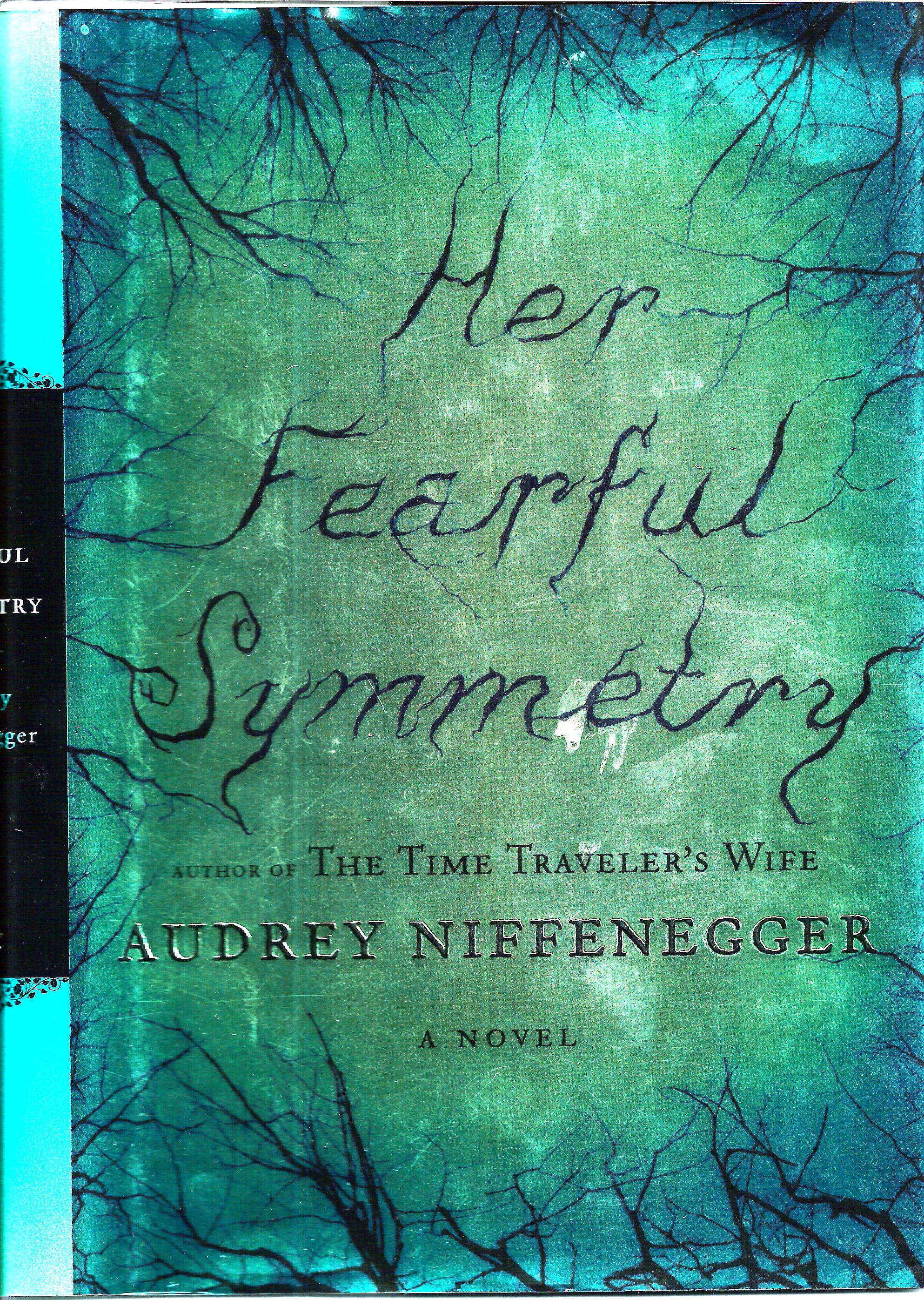
Next on this incredible list of silly buying decisions is a book I bought (paid full price) because the cover was pretty. I love the color aqua. Better still aqua when it has a shimmer effect like in the peacock’s tail feathers, or like the sheen of oil on the water. I hate to see oil on the water but that is how I would now describe this book’s cover-color. Another reason I bought it – the author wrote a fantastic first book (The Time Traveler’s Wife). This was her second book. A third reason I bought the book is the description on the cover flap was intriguing. A ghost story. I sometimes like ghost stories – especially if the story is from the ghost’s point of view – like in the movie “The Others“. Well, the story in Her Fearful Symmetry isn’t awful, just awfully written. Audrey Niffenegger tells more than she shows whenever there is any mention of ‘feeling’. For example “She felt tired.” It would have been just as easy to show me what “tired” looked like instead of just being lazy about it and telling me she was tired. Blah! I did get as far as the end of the book because the story wasn’t horrible, there were some good unanswered questions about the ghost, etc. The end result was satisfactory but not wonderful. The read through was a slog though. (Is that telling enough?)
I buy books from authors I love. I love P.D. James. I love Jane Austin. So put the two together and you have a book by mystery writer P.D. James called Death Comes to Pemberly. Sounds wonderful. It wasn’t. I tried to love it. Couldn’t. The writing feels forced and stilted. I know she was trying for a voice that sounded like someone writing like Jane Austin. P.D. James is usually one of the easiest author’s to read and enjoy. I’ve read every book she’s written and have loved them all until this one. I hope she writes more mysteries with the wonderful Commander Adam Dalgliesh to solve them and that she writes no more historical mysteries with an attempt to sound historical.
Monty Python and the Holy Grail (Photo credit: Wikipedia)
You only get that title if you remember Monty Python.
It is Book Review Wednesday at the Nolen house. Today’s totally different book review is on a non-fiction book. I read a lot of non-fiction books but I don’t usually review them here.
I started this book thinking it would be a quick read. I mean, look at it! Well, you can’t see it here. It is tiny. STEAL LIKE AN ARTIST or “10 Things Nobody Told You about Being Creative” by Austin Kleon. Who, by the way, lives in Austin, Texas and so does my fellow book-writer and friend Nikki Loftin (more on her fabulous book later). Nikki encouraged me to read this book. Thank you, Nikki! Should have been a quick read. This book is not a quick read for the simple reason that it is stuffed with good ideas that need to be mulled like spiced apple cider. Mulled apple cider is always better the day after. Yes, I said “mulled”. Or steeped inside that steamy caldron of a creative brain you carry on your shoulders. This is a fantastic book.
Also, I can’t believe I read a NYT’s best seller while it was still on the best seller list. That’s a first.
I don’t want to leave you wondering if I’ve lost it. Here are a few tips from the creative master Mr. Kleon: Don’t wait until you know who you are to get started. In other words, waiting for inspiration to hit you may see you old and gray before anything happens. I love his scribbles and multimedia artwork he uses to illustrate his points. He says “Fake it ’til you make it.” Great advice. You have to make some ugly art before the good stuff. If you’ve been to art school as I have and seen what you start with and then see what you end with on your “forced” projects you understand what this means. With writing it translates into the same thing. Some days what I have written is horrible. But Mr. Kleon says over and over – don’t ever throw anything away. He’s right. You never know when that “horrible” will spark something ingenious. All my work comes from ugly.
He quotes from Francis Ford Coppola — “We want you to take from us. We want you, at first, to steal from us, because you can’t steal. You will take what we give you and you will put it in your own voice and that’s how you will find your voice. And that’s how you begin. And then one day someone will steal from you.”
Another tip from the book: Write the book you want to read. I’ve always heard – write what you know. But I’ve always believed that you must write what you love AND what you want to read. If you write, you spend a LOT of time at it. You better love it.
One more tip from the book: Side projects and hobbies are important. How well I adhere to this! I can’t help it. I can’t help writing. Even if the writing is only in my head. I can’t help seeing the world around me with an artist’s “eye” although I haven’t touched a canvas in nine months. But life goes on and my projects may look to everyone else as though I’m sitting on my hands. They aren’t – my projects are brewing.
I don’t begin to do this book justice in a short review. I’m going to leave the other seven tips for you to read when you pick up a copy of “Steal Like An Artist”. You won’t be unchallenged, and unchanged if you do. I promise.
The stuff in the book may even be a sort of Holy Grail for writerly types.




 Rebecca Nolen