
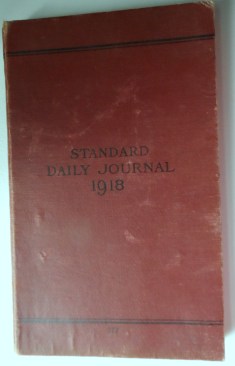
 When I was visiting my sweet cousins this past summer, cousin Jan came to me with a heavy-looking red book in her hands. She held it out to me, “I’ve read some of this. It’s Grandpa’s journal from his time in the army during World War One.”
Wow. Just wow!
As I flipped through it, I found some loose pages. I asked her what they were and she said she didn’t know.
All that afternoon, she and I transcribed what was Grandpa’s earliest recollections and his Christian testimony. I say ‘transcribed’ because his handwriting was nearly illegible. He was left-handed and his teachers taught him to write right-handed, you see. Some words we had to figure out letter by letter and then look up on the internet to try to decipher them.
So, I give you my Grandfather’s story, in his own words.
Early years
 Father was a blacksmith.I was born in Raymond, Iowa and moved to Ladora when I was 1 years old. We moved to Crawford, Colorado when I was 6 years old. In Crawford, Father died in the spring of 1900. I was nine years old. Mother brought my brother and I back to Iowa that year, after selling the blacksmith shop and the house in Crawford. We lived with her folks a few months. Then she bought the hotel in Washburn and operated that for several months. When she married Frank Hemmer we moved to Caliofe, Iowa, near Hawarden, lived there a few months and moved to a farm across the big Sioux River to South Dakota. Continue reading In His Own Words: My Grandfather’s Diary
 You’ve got a book. It’s ready to be published, but you don’t know the first thing about how to do that. You ask around. No, you don’t want to go through the traditional publishing route because it could be several years after your book is accepted for it to even see the light of day. You want your book published and you want it now, though you don’t want to self-publish either. It sounds like too much work.
 Rebecca Nolen